
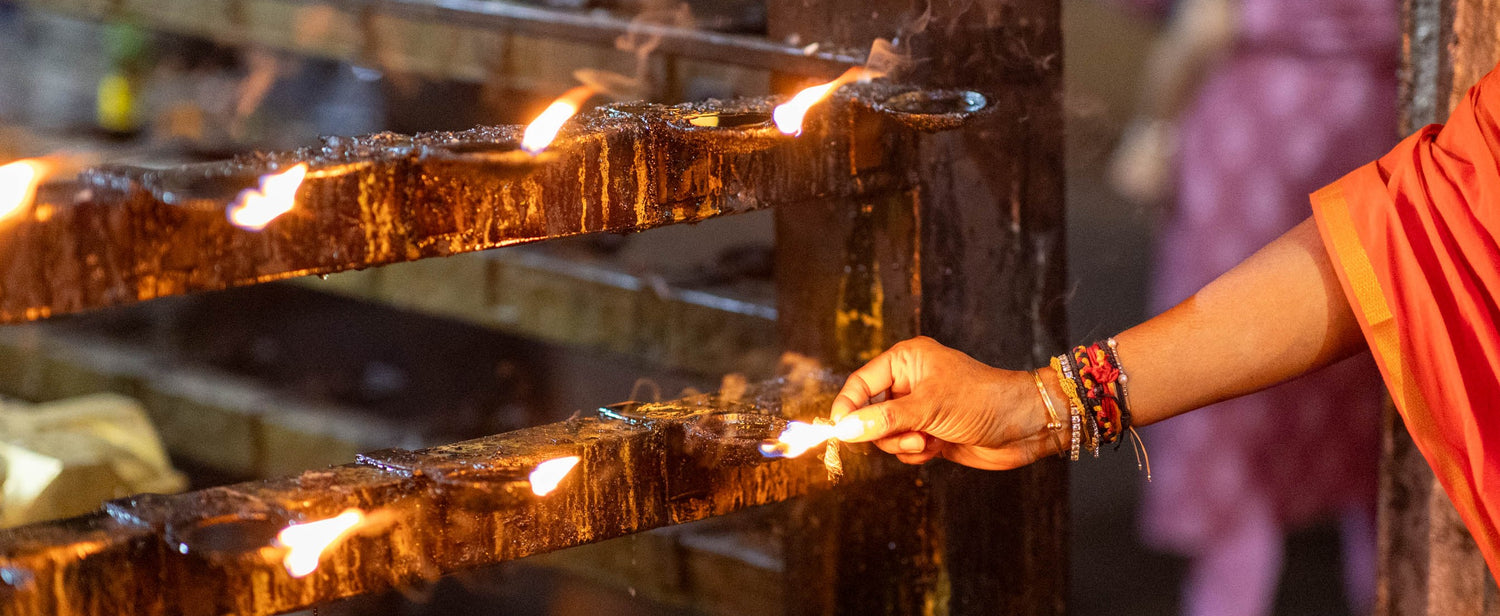

The story should have ended at the pillar.
Prahlada had said that Narayana was everywhere. His father pointed at a pillar and asked the question that would finish him. Is He in this one too? What came out was neither man nor animal, at an hour that was neither day nor night, on a threshold that was neither inside nor outside. Narasimha put the king across His thighs and tore apart more than a body. He tore apart the idea that a man can arrange existence so carefully that nothing gets through.
Most tellings stop there. Ahobilam doesn't.

The place sits deep in the Nallamala hills of Andhra Pradesh, about sixty kilometres from Nandyal and a good deal further from anywhere with an airport. The Nallamalas are held to be the Adishesha lying across the land, Tirumala at the head, Srisailam at the tail, Ahobilam somewhere in the middle of that body.
There are two settlements. Lower Ahobilam, which sits at the foot of the hills with the great Vijayanagar temple in it. Upper Ahobilam is eight kilometres up a narrow ghat road. Even that road stops short, ending near the Bhavanasini. From there on, everything is on foot. Nine principal forms of Narasimha are worshipped across these hills. Some you can drive to. Some need a jeep on a dirt track. Two need a serious walk. Above them all, the mountain itself becomes the pillar.

No single temple explains the place. Tirumangai Alvar sang of these hills as Singavel Kunram, the hill of the lion. His songs describe a wild country, which suits the One who lives in it. By the fifteenth century Annamacharya was singing of the nine. The kshetra shastra keeps the stories alive.
Prahladavarada Narasimha
Most pilgrims begin at Lower Ahobilam, in the temple of Prahladavarada Narasimha, who isn't counted among the nine at all. He's peaceful here. He is the Lakshmi Narasimha with Amritavalli Thayar in her own shrine. The complex has a rich pillared hall with Yakshas riding yalis. Horses with their hind legs on makaras. Figures from the Ramayana cut deep enough to hold shadow at four in the afternoon.
The sanctum tells you how this whole kshetra works. The utsava murtis of eight of the nine are kept here, including the ten-armed Jwala Narasimha with Sridevi and Bhudevi. The ninth, Malola, lives with the Ahobila Mutt. Before the hills scatter Him across nine shrines, the lower temple gathers Him back into one room.
The name is the other reason to start here. Prahladavarada, the One who gives Prahlada his boon. Before the mountain shows us nine forms, it reminds us why any of this happened. A child loved God. Take Prahlada out of the story and the fury is only frightening. Put him back and the claws have a reason, the roar has a reason, even the pillar has a reason.

Bhargava Narasimha
Then you leave the town and the mountain starts doing what it does. Two kilometres out, on a hillock in thick forest, is Bhargava Narasimha. The road there isn't really a road. It's a rocky track with the last stretch of a hundred and thirty-two steps up. Below the shrine lies Bhargava Tirtha or Akshaya Tirtha. It is a local tradition to bathe here, just like the Pushkar lake in Rajasthan. Tradition holds that whoever worships Him after that bath receives Lakshmi along with Him, so people come here asking for prosperity.
The deity is fierce. Four arms, conch in one, chakra in another, the other two tearing Hiranyakashipu open, Prahlada visible at His feet and the ten avatars carved into the carved arches behind Him. He is called Bhargava Narasimha after Bhargava Rama, who is Parashurama. Tradition remembers him doing tapas at this tirtha until Narasimha gave him darshan in exactly this form and then stayed in it.
So the first thing the mountain shows us is one avatar worshipping another. And the one doing the worshipping is Parashurama, the man with the axe, whose whole story is anger and duty and consequence. Here he isn't fighting anyone. He bathes in the tirtha, he sits, he does tapas for as long as it takes.
Parashurama could have gone anywhere. What he did here was stop and wait by the water. The darshan came while he was sitting still. That's worth remembering, because some of us only know one way to meet life. We take it on. We carry what nobody else will carry. We fix things and we keep going. It works for years, until we can't tell the difference any more between doing that and being ourselves. The first shrine on this mountain belongs to a man who put his axe down and sat by a tirtha until God came.

Yogananda Narasimha
Yogananda is about the same distance from the town on the other side. You can drive most of the way, which after Bhargava's rocky track feels almost like a courtesy. The shrine is a quiet one. The Lord sits here in a yogic posture. Tradition connects the place with what happened after the killing, when Narasimha taught Prahlada the yoga sastra through a series of asanas. That's where the name comes from. Yogananda, the One whose joy is in yoga. Devotees come here asking for steadiness of mind. It's the shrine where people stay seated longest.
Those two are two kilometres apart. At the first, the Lord has a body open in His hands. At the second, He's teaching a child how to sit. Almost nobody tells this part of the story. It usually ends at the pillar, with the boy safe. But Prahlada was seven years old and his father was dead. He now had a kingdom and a whole life in front of him that nobody had prepared him for. That is why Narasimha stayed and taught him.
Most of our prayers are for our rescue. Get me out of this. Make it stop. Fix or heal. Sometimes it does stop. Then comes the ordinary morning after, when nothing is on fire and we still don't know how to live. That morning is what this shrine is about. Narasimha stayed and taught the boy how to sit, how to breathe, how to keep his mind steady for the rest of a long life.

Chatravata Narasimha
Chatravata is also on a motorable road. The shrine sits under the spread of a tree that gives it the name. The story tells us of the Gandharva Haha and Huhu coming here to offer their music, with the Lord pleased enough to grant them mastery of their art. And if you look at His hand, it's held the way a person holds it when they're keeping tala.
Six kilometres from the town, the hands that tore Hiranyakashipu apart are keeping time.
We turn sadhana into something grim more often than we need to. There are tapas and discipline, there is everything in us that must change. However, there is also this. A musician who stands in front of Chatravata is probably not going to worry about whether his voice is good enough. He's going to wonder how he'd sing if he knew somebody was listening.
Karanja Narasimha
Karanja Narasimha sits under the karanja tree that gives Him His name. Something about Him looks wrong at first. He is carrying a bow here. This explains why He is also called Saranga Narasimha, after Saranga, the bow of Rama. The story speaks of Hanuman, who once sat here meditating on Rama when Narasimha appeared in front of him. Hanuman refused to acknowledge Him. His Lord was Rama. There is something almost funny about it. God turns up before His devotee and the devotee refuses to see Him.
Narasimha wasn't offended by that. He took up the bow and came as Rama instead. Hanuman had given himself so completely to Rama that there was no room left in him for another name. Instead of correcting him, the Lord arrived in the form Hanuman could receive.

Ahobila (Ugra) Narasimha
The ghat road then climbs eight kilometres to Upper Ahobilam and stops near the Bhavanasini. From where it leaves you, for the rest of the way to the shrine one climbs the stone steps. They are steep in places, with monkeys keeping company the entire way.
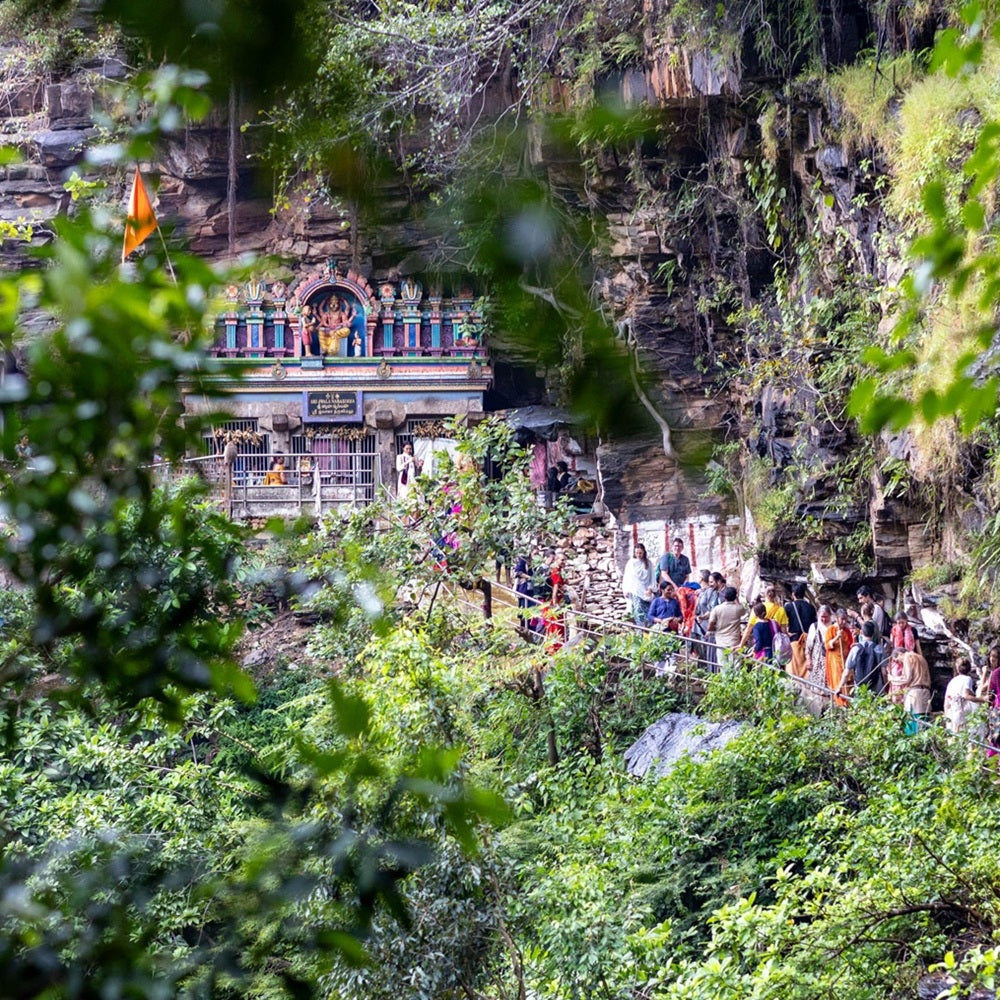
The principal shrine there is a cave. Its sanctum is low-roofed enough that one enters bent over, which changes how it feels to come up in front of Him. This is Ahobila Narasimha, the Ugra Narasimha, a swayambhu/self-manifested, seated rather than standing, facing east. The scriptures describe His fangs and claws frightening to fear itself. Chenchu Lakshmi has a shrine beside Him. The utsava murti of Jwala Narasimha receives daily worship. This is important since not everyone who reaches Upper Ahobilam can make that walk.
Prahlada is there with Him. The fierce face is turned towards the child. Everything about the shrine rests on that. Everyone in that hall had been terrified of Him except the one person He'd come for.
Hiranyakashipu had spent his life building security. The boon he took from Brahma read like a contract against death, covering indoors and outdoors, day and night, earth and sky, man and animal. He'd thought of everything, or believed he had. His son had no protection at all. He had Narayana.
We write our own versions of that boon. Money, position, health, reputation, a plan for what happens next. Underneath them sits the belief that if we arrange enough of it well, nothing unbearable can get to us. Then life finds the clause we forgot to write.
Kroda (Varaha) Narasimha
A little further along the same rock, in a cave of its own, is Kroda Narasimha, also called Varaha Narasimha. His face is that of a boar and hence the two forms meet in one image.
Varaha is the avatar who went downwards. When the earth was lost in the waters, Sriman Narayana went in after her and carried her up on His tusks. That's the opposite of what we've been doing all morning. We've been climbing. Here is the Lord who descended, sitting in a cave halfway up a mountain we walked up to reach Him.
He didn't leave the earth where she'd fallen. Most of us have written something off as unrecoverable. Trust, after someone used it. Faith, after the thing we prayed for didn't come. The tenderness we had before we learned what people do with it. We stop looking for them and build the rest of life around the gap. The Lord in this cave is the One who went down after what was lost.

Malola Narasimha
Malola is on the same stretch. After the caves and the fierceness, the image can stop a person. Lakshmi is seated with Him. Ma is Lakshmi. Lola is beloved. The claws haven't gone anywhere, which is the part worth noticing. He isn't weaker than He was at Jwala. He's strong in a way that has become safe to come close to.
This is the form the Ahobila Mutt was built around. Tradition holds that a young scholar named Srinivas Acharya was called to these hills by Narasimha in a dream. On the banks of the Bhavanasini the Lord met him as an old man and gave him sannyasa with His own hands. He became Adivan Satakopa, the first Jeeyar. The Mutt has continued from him in an unbroken line for six centuries.
Malola is the presiding deity, which is why His utsava murti isn't kept with the other eight in the lower temple. He goes with the Jeeyar. The Lord of hills that take a jeep and a river crossing and four hundred steps to reach travels out to wherever the devotees are, so that for a great many families the first Narasimha they ever saw was Malola arriving in their own town.

Jwala Narasimha
Jwala is the one that costs something to reach. It's three and a half to four kilometres from Upper Ahobilam, up along the Bhavanasini towards the peak of Achalachaya Meru. There's no proper trail for most of it. You walk in the stream bed itself. Pilgrims cross it ten or twelve times before you get there. In the months after the monsoon the water is knee deep and moving fast enough to be felt. Ropes are tied across the harder crossings to hold on to. By summer the stream dries up making the walk much easier. The shrine itself sits at the top of about four hundred and fifty steps that run up beside a waterfall. Allow two hours to get there and two to come back, more if the water is high.
Jwala means flame. Temple tradition places this spot where the fury reached its full height. The shrine is built right up against the rock face, with no tower above it. Look closely at the murti and you notice something. Hiranyakashipu isn't there. The killing this whole place is named for has been left out of the image. There's just the Lord; Lakshmi seated on His right and Prahlada standing on His left. All the fire is in His face.
It's fair to question why? The answer is that Love is not always gentle. A mother yanking her child back from a moving car does it hard enough to hurt the arm. Anyone who has ever had to stand between someone weak and someone willing to hurt them knows the feeling that comes up. It is not calm. Narasimha wasn't defending His own name. He was defending a seven-year-old who had been thrown off cliffs and fed poison for saying that God was everywhere. What we're looking at in that face is what love does when someone touches the one it belongs to.
There's a pool near the shrine called Rakta Kunda. The tradition here is that Narasimha washed His hands in it once the killing was done. Devotional memory explains the reddish colour of that water through the same story. Of everything the story holds, that's the part I keep returning to. He finished. Then He went to the water. The anger had done what it came to do. He left it there. That's the part we can't manage. We finish nothing. We're still replaying the conversation years afterwards, still sharpening the line we should have used at the time. We keep the evidence. We hold on long after the anger has stopped protecting anybody, until it's just the room we live in. Guruji has said that anger held for our own sake burns only the one holding it. The pool is still there beside the shrine. Nobody makes anyone wash anything in it.
Malola sits on the way back down, so most people reach Him an hour or two after leaving Jwala, still wet to the knee and still carrying that face in their mind. Then it's the same Lord with Lakshmi leaning into Him. At Jwala the strength was protecting somebody. At Malola, it’s gone quiet enough for somebody to rest against. A person needs both. Most of us only ever learn one.

Pavana Narasimha
Pavana is the farthest of the nine and the one most people give up on. It's deep in the forest, an hour of jeep track through the trees before anything appears. The shrine stands beside water with nothing else around it for miles. Pavana means the One who purifies. The scripture ties this place to release and tells of Bharadvaja receiving it here. There is a Chenchu Lakshmi shrine in the same area where the forest people have brought their offerings for generations.
It figures that the shrine about letting go is the hardest one to get to. Purification is a lovely word until it's your turn. Then it means putting something down. Pride, ego, resentment we have been feeding for years. Shame nobody knows about. Jwala was about destroying what attacks us. Pavana is about releasing what we carry by choice. There are hours of forest between those two shrines, which feels about right.
The nine shrines still don't cover everything Ahobilam is. The Chenchus have lived in this forest for generations. Their stories remember Narasimha as someone who walked into it and fell in love with one of their girls, Chenchata or Chenchu Lakshmi. It is said that she doesn't fall at His feet because a great deity has appeared. This was her land and He was the outsider, and so He had to pass her tests. He had to learn the ways of her people before she agreed to the marriage.
Chenchu Lakshmi has her shrine beside Him in the cave at Upper Ahobilam as well as near Pavana. The Chenchus keep their part in the ritual life here. The Lord who came out of a pillar becomes family. The closer He comes, the less formal any of it gets.

Ugra Stambha
Higher than all nine shrines, there's a split in the rock that people here call Ugra Stambha. Tradition holds it to be the pillar itself; left standing open from the moment He came out of it. The other name for it is Ukku Stambha, the steel pillar. It's the hardest climb and most pilgrims see it from below without going up. Those who do climb are shown a mark near the top that's revered as the feet of Sri Chaitanya Mahaprabhu, who came here on his travels through the south.
Consider where the pilgrimage has taken us by then. It started in a built temple with carved pillars and a walled courtyard. After that we found Him beside a tirtha, under trees, inside caves. He was a teacher at one shrine and a listener to music at the next. He came as Rama because Hanuman would have nobody else. He came as the boar who went down into the water. He sat with Lakshmi. He burned. He purified. Among the Chenchus He married in and became somebody's son-in-law. And at the very top of it all there's no temple at all. No sanctum, no walls, nothing anyone built. Only a rock with a split down it. And a question somebody asked a very long time ago. Is He here too?
No old text walks Narasimha through these nine forms in order after the killing. These are separate stories. The shrines themselves grew over centuries out of scripture and local memory and the people living in these mountains. The sequence isn't ancient and prescribed. It's what the hills let a pilgrim see.
We go there wanting to understand Him and the mountain takes that away, until it's hard to say what Narasimha should look like or where He should appear or who He should come through. Then we're standing at a split in a rock with Hiranyakashipu's question in our mouths.
Prahlada knew the answer before any of us started walking. Yes. Hiranyakashipu's mistake was not that he looked for God in a pillar and got it wrong. It was thinking there was anywhere God wasn’t.
- Amrita Dasi

Leave a comment
This site is protected by hCaptcha and the hCaptcha Privacy Policy and Terms of Service apply.