
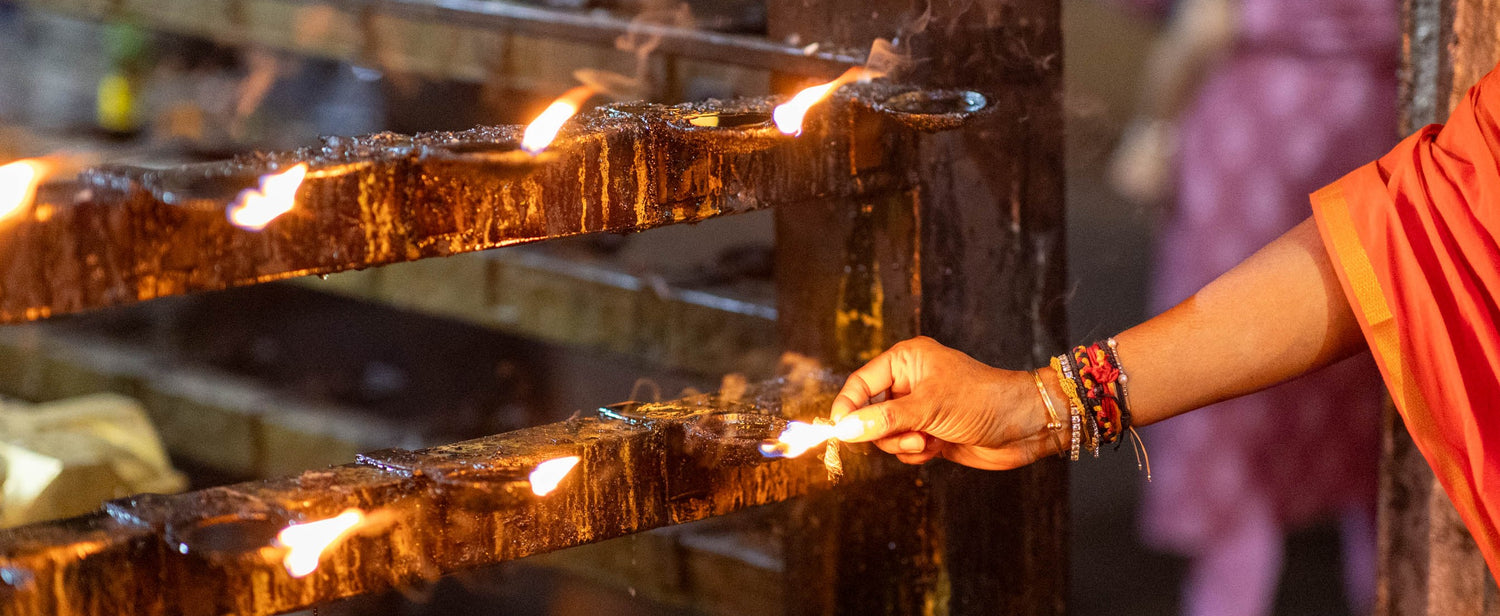
'Whenever I am at Govardhan, I am always very happy. My heart is always overflowing with joy here. Just to see Him and step on His land is already a source of great happiness for me. At Govardhan, I have met many wonderful people — saints and sadhus — whose lives have become examples of devotion and love for me. One of these people is Uddhav Das Baba, who lives near Kusum Sarovar. A number of incredible events have taken place here, some of which are described in the Puranas, and it was here that a deity of Uddhav was established by Krishna’s great-grandson. From the very beginning, the deity has been served by the family of Uddhav Das Baba.

Gurudev has met Baba several times and, during Holi 2025, He visited the temple of Uddhav and Uddhav Das Baba Himself, along with the devotees. Baba won our hearts with his kindness and gentleness. With shining eyes, he told us a lila of Radha and Krishna that took place at Kusum Sarovar.

I was also fortunate to speak with Baba on several occasions and ask him about his life and about Kusum Sarovar. So, I am happy to share with you the story of this place and what Baba told me during our meetings.'
- Swamini Abhirami
Kusum Sarovar

 The name of this temple complex translates from Sanskrit as the ‘Lake of Flowers’. It is the place where the gopis would usually gather flowers for their pujas, and Krishna would tease them with His playful mischief, stirring a storm of irritation, delight, love, and joy in their hearts.
In front of the temple lies a kund (sacred pond) of extraordinary depth. Some believe it has no bottom, while others claim it reaches a depth of 60 metres. Large turtles dwell here, revered as great sages. They have lived in Kusum Sarovar for centuries, meditating on the lilas (divine pastimes) of Radha and Krishna. It is here, by this sacred lake, that Srimati Radharani and Krishna secretly meet in the early mornings.
One day, Radharani and the gopis were picking flowers here for puja, when a gardener appeared before them. With a long moustache, a large turban, and a heavy stick in his hand, he looked extremely angry. He began scolding the frightened girls, accusing them of stealing his flowers every day and leaving him with nothing to offer his deity. He then began threatening them with punishment.
The poor gopis were terrified. Radharani’s hands trembled, and She dropped her flowers to the ground. As She bent down to pick them up, She noticed a flute hidden beneath the clothing of the fearsome gardener.
Her mood changed instantly. Without picking up a single blossom, She stood up, filled with resolve and a little annoyed with Her Kanha. Radha said, ‘Vanamali, now You shall collect My flowers.’ The gopis were confused — only a moment ago, Radharani had been scared, and now She stood tall and stern. ‘Vanamali, bring Me My flowers,’ She commanded.
Krishna realised He had been found out and surrendered. The mood shifted instantly. Radharani told Krishna they had no time for games and that He should take the flowers and wash them in the Yamuna so that She and Her friends could leave without delay.
The gopis, realising what was happening, joined in, scolding Krishna for His troublesome behaviour. They reproached Him for ruining their plans once again and reminded Him they were in a hurry to return to Barsana. Radharani told Krishna, ‘Hurry and wash our flowers in the Yamuna. You are wasting our time.’
Then Krishna, the master and sovereign of the hearts of those in love with Him, struck His flute into the ground — and in that very moment, a kund appeared. Water rushed forth and the entire place bloomed with beautiful lotuses. The Lord gathered these lotuses for Radharani and the gopis, but they no longer wished to leave. The lovestruck girls forgot all their plans. Now, any reminder that it was time to go stirred a storm of protest in their hearts. Overjoyed, they began to play and dance with Krishna.
Another beautiful lila related to flowers took place at Kusum Sarovar. One day, Radharani saw some exquisite flowers growing high on a branch. She wanted Krishna to decorate Her hair with them, but Krishna said, ‘No, leave them.’ Unsatisfied, Radharani reached for the flowers Herself. She asked Krishna to hold the branch so She could pluck the blossoms growing higher up. Suddenly, Krishna let go of the branch, and Radharani was left hanging from it. She cried out, ‘Save Me!’— She let go, and of course, Krishna caught Her. In that very moment, the beautiful flowers vanished, for they had existed solely so that this sweet lila could unfold.

Once, after the great sage Narada Muni heard from Vrinda-devi about the glory of the gopis, he developed a strong desire to become a gopi and serve Radha and Krishna. He began meditating and praying for this. Vrinda-devi then immersed Narada Muni in the waters of Kusum Sarovar, and he emerged as a gopi named Naradi.
After taking part in the Rasa-lila, Naradi returned to Kusum Sarovar, and Vrinda-devi again immersed her in the lake. Narada Muni emerged once more in his original form.
Having participated in the Rasa-lila, Narada Muni sat in the forests of Govardhan, overwhelmed by feelings of separation from the Lord — experiencing the same emotions that Srimati Radharani and the gopis felt when Krishna left to tend the cows. Narada Muni wept, and from his tears, another beautiful kund of Govardhan was formed — Narada Kund.
The Story of the Temple
of Sri Uddhava at Kusum Sarovar

Taken from the Skanda Purana, Section 6: ‘Bhagavata Mahatmya’
After Shri Krishna’s departure from Earth, many chose to renounce worldly life and retreat into seclusion — including the Pandava brothers, led by their eldest, Yudhishthira. He relinquished the royal throne, passing it to his grandson Parikshit and great-grandson Vajranabha. Parikshit remained to rule in Hastinapur, while Vajranabha governed in Mathura.
The queens — Sri Krishna’s wives — went to Mathura together with their great-grandson, Vajranabha.
One day, King Parikshit decided to visit his nephew Vajranabha. Though delighted by the visit, Vajranabha was troubled. Despite being crowned king in Mathura, he found himself living with his great-grandmothers in a deserted forest, puzzled by the disappearance of the local people.
Parikshit then invited the sage Shandilya and the priest Narada to shed light on the matter. Shandilya explained that Vraj remains the eternal dwelling place of liberated souls; however, after Krishna’s departure, ordinary people left this land.
Shandilya explained that three types of people had been living in Vraj: ordinary people, incarnated devas (divine beings), and those who desired only Krishna.
- After Krishna’s departure, all the devas were transported by Him to Dwarka, where Krishna then absorbed them back into Himself.
- Those who desired only Krishna and loved Him unconditionally remained in Vraj in the form of love and bliss. They merged with Him and became invisible.
- Thereafter, ordinary people — those who had come to Vraj or were born there simply to witness the Lord’s lila — could no longer see Krishna or His beloved associates. They, too, left the land.
Shandilya then instructed Vajranabha to repopulate the villages of Vraj with new inhabitants and departed.
Following this, thousands of people were brought by Vajranabha to the land of Vraj, and many settlements were established. The sacred sites of Krishna’s lilas were given names and restored by him for worship. Many of the murtis (deities) still worshipped today were originally installed by Vajranabha, the great-grandson of Lord Krishna.
The new inhabitants of Vraj lived happily on the sacred land under the wise rule of Vajranabha, and his kingdom flourished.
Yet despite dwelling in this blessed place and enjoying external prosperity, Krishna’s queens were tormented. They wondered why Yamuna — who had also participated in the Divine Lila and, like them, was a consort of Krishna — did not grieve His departure. На contrary, she seemed full of joy.
They asked her, ‘Just as we were Krishna’s wives, so were you, O beautiful Lady. We are shaken and distressed by separation from Him — why aren't you? Tell us, why is that?’
Yamuna replied that in Vraj she still continues to serve Radharani, who is eternally present there. And since Radha is Krishna’s very soul, it means that Yamuna has never stopped serving the Lord and has never been separated from Him.
Yamuna continued: ‘You, too, are not truly separated from Krishna. But you do not realise this — that is why you suffer. Long ago, when Akrura (the minister of Kamsa, Krishna’s cunning uncle) came to take Krishna away on Kamsa’s orders, the gopis were also devastated by the seeming separation. But that pain was dispelled when Uddhava (Krishna’s devoted servant) arrived. If you meet him here, you too will be able to endlessly relish your Beloved.’
Uddhava was always absorbed in Krishna and was also highly learned in the sacred texts. He was Krishna’s cousin, served as His minister, and closely resembled Him in appearance. But despite his devotion, the Lord had not yet bestowed bhakti upon Uddhava. What continually amazed Uddhava was how Krishna — the King of Dwarka, with 16,000 wives and everything one could possibly desire — would often fall into quiet contemplation, as if longing deeply for something. When Uddhava asked Krishna what was on His mind, Krishna would reply, ‘I wish My Vraj were with Me...’
Meanwhile, in Vraj, the residents longed for Krishna with unbearable intensity, desiring His presence every moment. The Lord then decided to send Uddhava there — to bless him with bhakti and to bring His gopis back to Him.
Uddhava arrived in Vraj intending to enlighten its inhabitants, unaware of the profound blessing he himself would receive from that encounter. When the cowherd boys and girls saw him from a distance, they ran towards him headlong, thinking it was Krishna Himself — only to be crushed with sorrow when they realised it was not Him. Uddhava explained he had come on the order of Lord Krishna to share the secrets of the sacred scriptures. Но the gopis and gopas replied that studying the scriptures requires a mind — and they no longer had one.
‘That Shyama, the deceitful cowherd, the son of Yashoda and Nanda, has stolen our minds. How can you teach us anything when there is nothing left in us but Him alone? We would like to turn our thoughts away from Him, but this longing for Him, this pain of separation, leaves no room for any other thought.’
In the presence of such exalted devotees, Uddhava himself became immersed in bhakti. He agreed to share scriptural knowledge — but only by speaking of the Lord and the lilas with His devotees, so that the gopis and gopas would not have to divert their minds from Krishna. Thus, he began to narrate the Shrimad Bhagavatam. This knowledge liberated the residents of Vraj from the agony of physical separation from their Beloved, and they were eternally united with Him.
Inspired, the queens asked Yamuna how they could meet Uddhava. She replied that before leaving the Earth, Krishna had instructed Uddhava to remain in two places:
- Badari (Badrinath in the Himalayas) — the land of preparation for attaining the highest goal. There, Uddhava remains in a visible form, spreading the knowledge of Krishna.
- Vraj — the land where the fruits of penance are fully tasted. Uddhava remains here even now, invisible, in the form of a special kind of creeper that grows low along the ground — for he longed for the dust from the feet of the gopis and gopas.
Yamuna also revealed that Krishna had told Uddhava that in Vraj, the presence of the Lord should be celebrated eternally. Therefore, all the queens, together with their great-grandson, King Vajranabha, were to remain in the area around Kusum Sarovar. On the instruction of Yamuna-devi, they were to gather all those who were deeply devoted to the Lord and begin glorifying His Names — singing, dancing, and playing instruments. ‘When the great celebration is in full swing, Uddhava will not be able to stay away. This meeting will undoubtedly lead to the complete fulfilment of your aims,’ the goddess Yamuna told the queens, Vajranabha, and Parikshit.
King Parikshit immediately organised the celebration at the designated spot near Kusum Sarovar.
The festival of Krishna’s glorification began at the Flower Lake (Kusum Sarovar), in Sahisthala near the forest of Govardhan. When dancing and kirtan once again resounded through Vraj and people directed all their thoughts and desires solely towards Krishna, Uddhava emerged from the thickets, shedding the form of a creeper. He had a dark complexion, was adorned with garlands, and was dressed in yellow garments, constantly singing the glories of the Beloved of the gopis.
At the spot where the creeper detached from its roots and Uddhava took human form, a hollow remained — it later widened into a pond and became known as Uddhava Kund.
Seeing Uddhava’s striking resemblance to Krishna, everyone present was filled with joy. He began to speak about the importance of hearing and chanting the Lord’s Names and the Shrimad Bhagavatam, explaining that this is the path to realising Krishna Himself and His pastimes within one’s heart. He said he had come to relieve them of the suffering of separation from the Lord.
Uddhava revealed that the knowledge of the Shrimad Bhagavatam had been bestowed upon him, and that the power of this knowledge is so great it could grant liberation.
For a month, Uddhava recited the Shrimad Bhagavatam to all who had gathered at Kusum Sarovar — to everyone except Parikshit, whom he sent back to Hastinapur to fulfil his royal duty. Before parting, Uddhava told the disheartened Parikshit,
‘O King, you need not worry about anything, for the most important person mentioned in the Shrimad Bhagavatam is you yourself. With your help, many in Bharata (India) will attain eternal joy through hearing the Shrimad Bhagavatam. The great sage Shuka will surely narrate this wisdom to you, and you will reach the Lord’s eternal abode. From then on, the Shrimad Bhagavatam will begin to spread across the world.’
And so, after Parikshit’s departure, Uddhava continued narrating the Lord’s lilas. Day by day, the queens became increasingly immersed in them until they finally dissolved into the divine pastimes and became part of the spiritual Vraj, hidden from the eyes of ordinary people. Healed from the pain of separation from their Beloved, they attained Him fully.
Having finished his narration, Uddhava told those present that, by his own will, he always remains in this place, ready to share the wisdom of the Shrimad Bhagavatam with those who are ready to receive it.
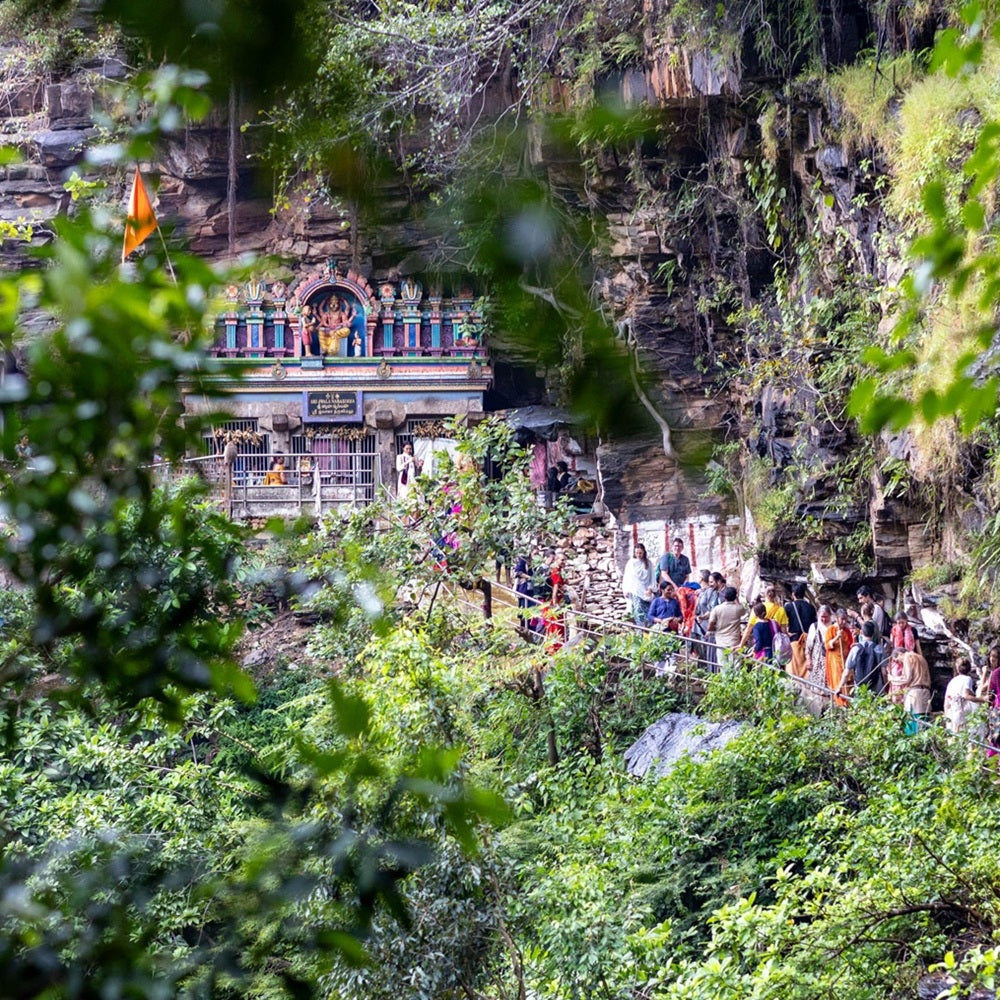
Following these events, Vajranabha installed three murtis of Uddhava, which are still worshipped to this day. One is in Dwarka, where Uddhava served Krishna as His minister, and the other two are in locations pointed out by Yamuna-devi: one in Badrinath, and the other at Kusum Sarovar — the very place where all these pastimes took place. Today, at Kusum Sarovar, a temple stands where that same deity of Uddhava is served daily by the family of Uddhav Das Baba.
The Deities in the Uddhav Ji Temple

- The main deity in the temple is Sri Sri Thakur Uddhava Ji Maharaj, established 5,000 years ago by Vajranabha. The murti of Uddhava is shown holding the Shrimad Bhagavatam in his hands.
- Yamuna Devi and Rohini took part in this divine lila, so their deities are also present in the temple. Yamuna Devi’s murti is blue, the colour of her Beloved Krishna. The other deity is Rohini — the eldest among the women who arrived in Vraj with Vajranabha.
- The deity of Vajranabha, Krishna’s great-grandson, is also worshipped in the temple. It was installed around 700–800 years ago by the ancestors of Uddhav Das Babaji.
- The newest deities in the temple are Radha and Krishna, installed by Uddhav Das Babaji himself. There is a remarkable story behind them: Babaji deeply desired that Radha be placed on the right side of Krishna on the altar — not the left as is traditional — in honour of the lila of Kusum Sarovar, where Radha and Krishna met in secret before being wed by Lord Brahma in Bhandirvan. But all the deity carvers insisted on placing Radharani to Krishna’s left, as His wife. Babaji was heartbroken. He wished to see Radha and Krishna as they danced at Kusum Sarovar before their wedding. Despite his heartfelt prayers, nothing seemed to work — the craftsmen simply wouldn’t listen. Then, one day, someone unexpectedly brought a set of deities and left them at Uddhav Das Babaji’s house. These were Radha and Krishna in Their pre-wedding form — just as Babaji had longed for. And thus, after many prayers, Radha and Krishna came to the temple unmarried, as They are in the secret lilas of Kusum Sarovar.
- A Shaligrama (sacred black stone form of Vishnu) is also worshipped in the temple, and it has a wondrous story of its own. The family of Uddhav Baba has served this Shaligrama for many generations. About 500 years ago, the Shaligrama changed its form. One day, it was found no longer in its natural ammonite shape, but carved in the form of Satya Narayana Krishna.
About Uddhav Das Babaji
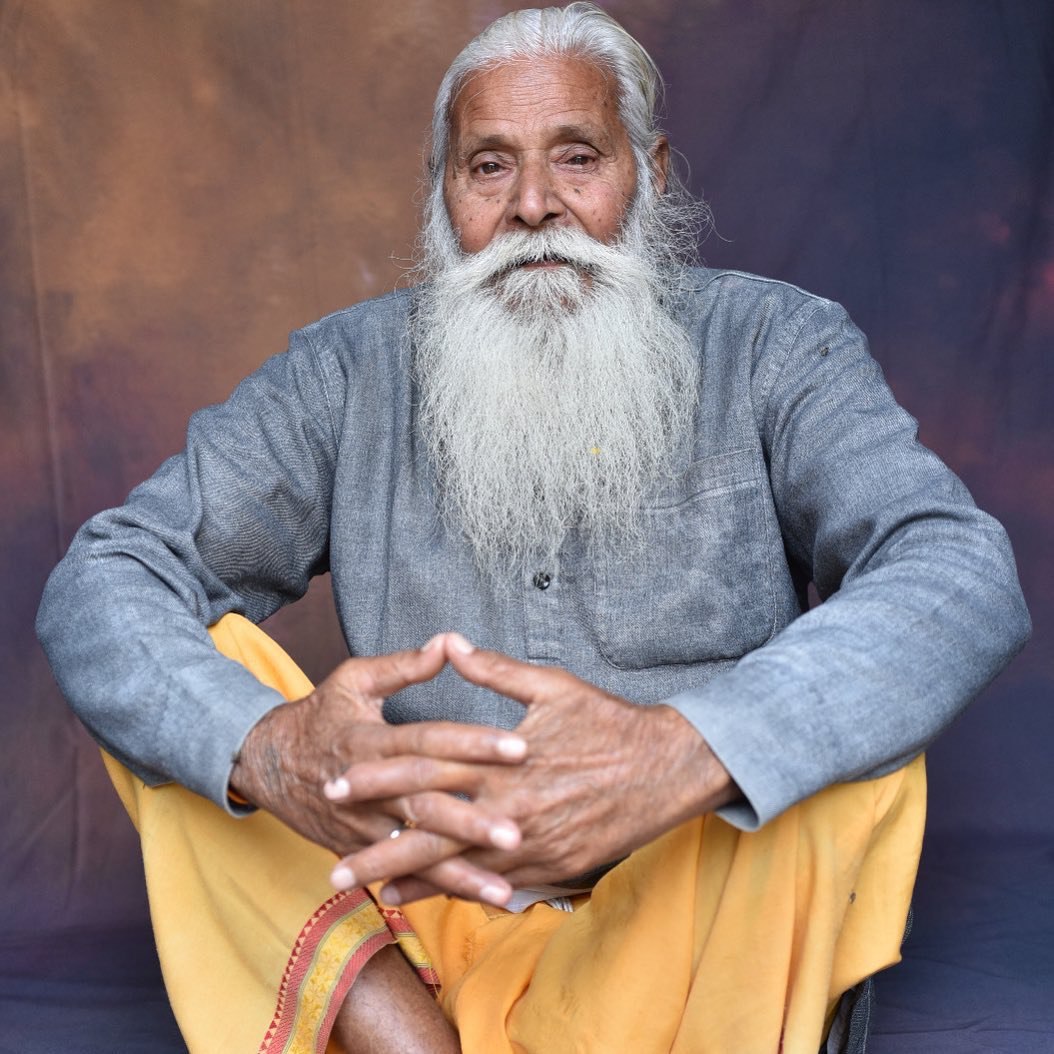
Uddhav Das Babaji belongs to the lineage of Braj Jan brahmins. His father, Braj Kishor, was a freedom fighter during India’s struggle for independence from colonial rule, and his mother, Sharavati Devi, was a housewife.
Babaji himself says,
‘Our family has always lived near Kusum Sarovar. We belong to this place and to the temple of Uddhav Ji. All my ancestors and family members were born here.’
He was born in the temple of Uddhava and grew up immersed in a deeply devotional atmosphere, serving saints, devotees, and cows. One of the family’s traditional services is to feed the sadhus who perform Govardhan parikrama (circumambulation of Govardhan Hill).
 |

|
Babaji’s house is located directly opposite Kusum Sarovar, and behind the house is a goshala (cow shed). The family looks after more than 20 cows, whose milk is used for prasad and to feed sadhus. A dedicated kitchen has been established for this purpose — to nourish the many holy people who pass through.
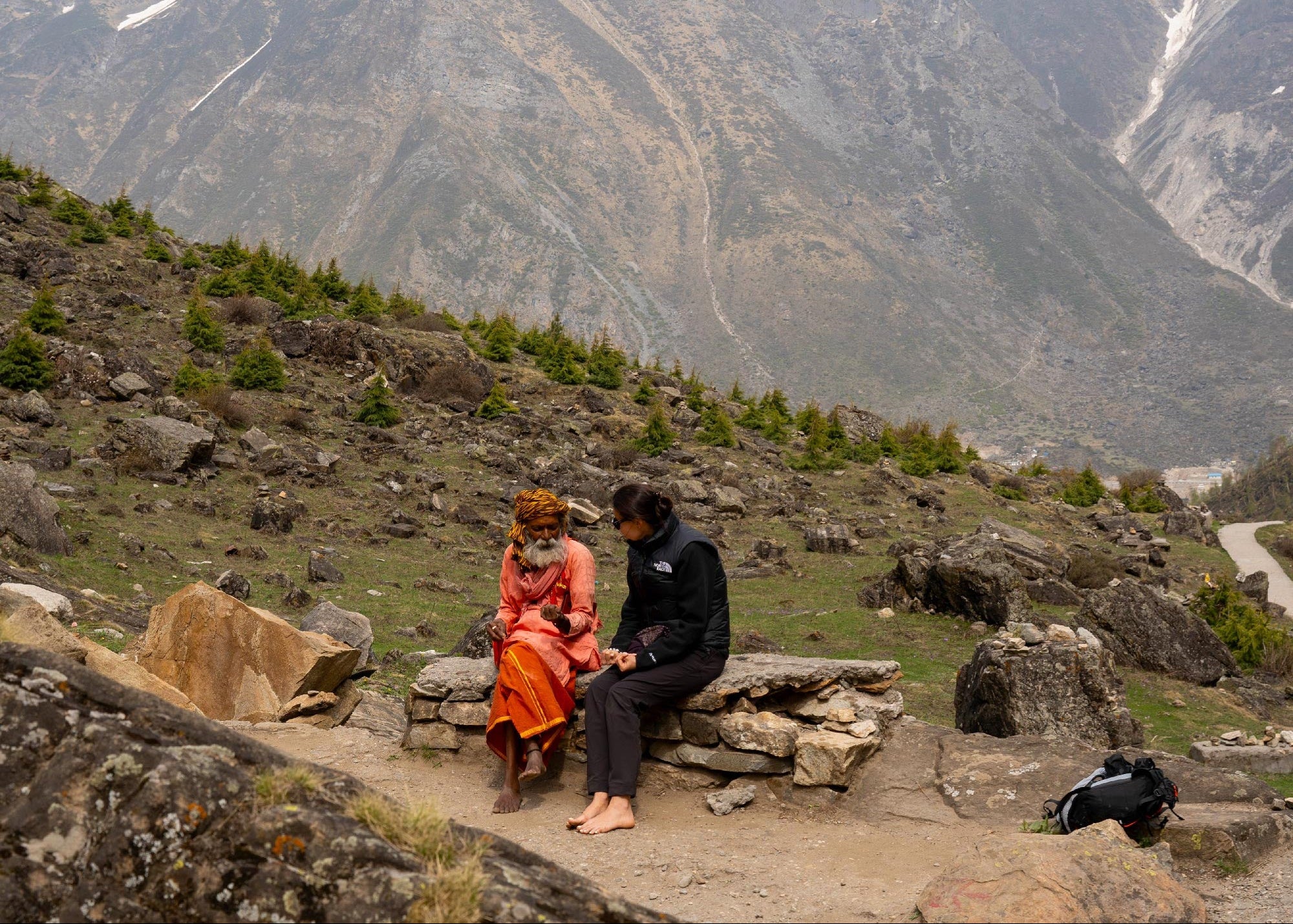
Even as a child, Uddhav Das Babaji was blessed by the presence of many great spiritual masters who visited the area during their Govardhan parikrama. Little Uddhav would spend hours in their company, and he has shared many beautiful stories about the exalted souls he had the fortune to meet growing up near Kusum Sarovar. These included Devaraha Baba, Srila Prabhupada, Radhe Radhe Baba, Tatambari Baba, and many others.
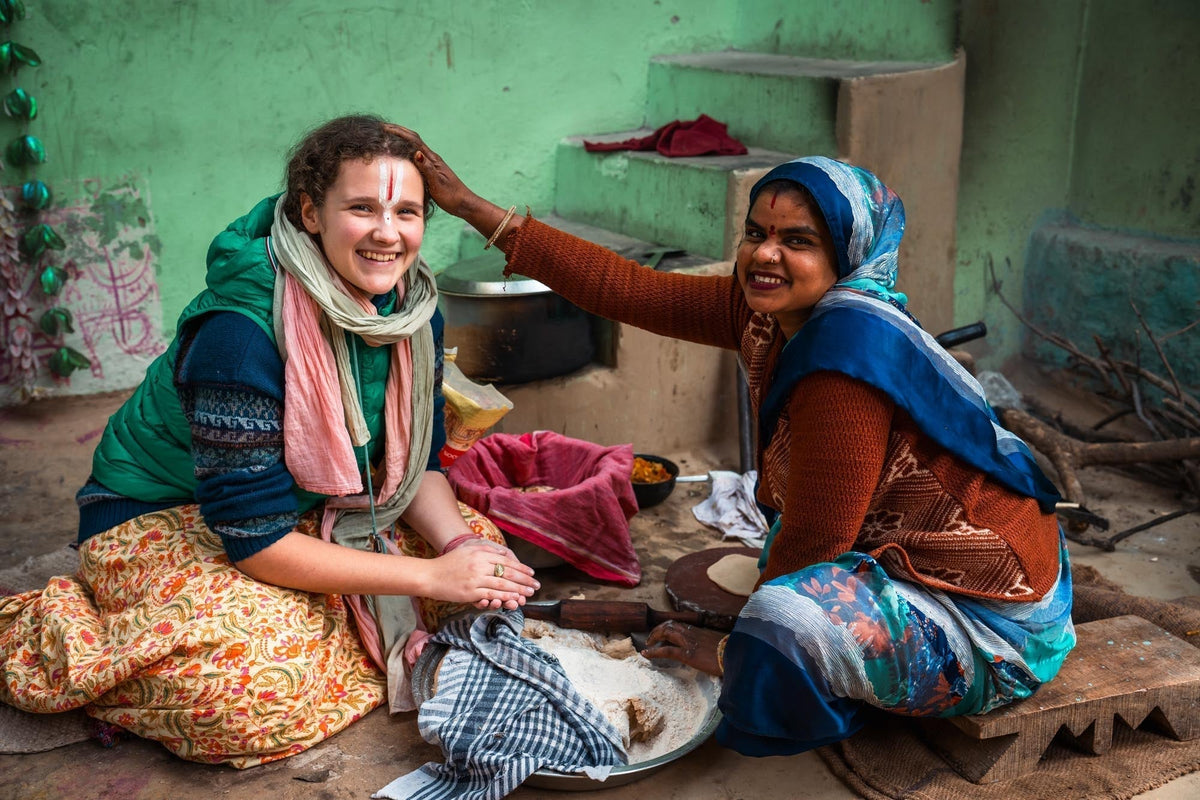
Uddhav Das Baba spoke to us with deep emotion about how Radhe Radhe Baba, who lived for many years side by side with his family and used to feed sadhus at this very spot. Every day, he would prepare a small batch of rotis using about two kilos of flour and offer them to anyone who came. Sometimes over a hundred people would be fed — but miraculously, the basket of rotis never emptied as long as there were still those who wished to eat.
‘Everyone is born. Everyone dies. No one stays here forever. People come — some are hungry, some are weary… But whatever their state, if someone wishes to receive prasad, they will receive it here. You simply have to ask, and it will be given. That is how it has always been in my family, and that is how Radhe Radhe Baba served others,’ said Uddhav Das Babaji.
As a child, Babaji was very mischievous — his parents often compared him to Krishna. One day, when he was about 7 or 8 years old, he had a memorable encounter with Srila Prabhupada.
At the time, Srila Prabhupada often stayed near Kusum Sarovar, singing bhajans, and Babaji’s family would usually offer him lunch. In those days, Prabhupada was still relatively unknown and accessible. He had great affection for little Uddhav and would sometimes play with him. But Uddhav was naughty and often teased Prabhupada, who would speak to him about chanting mantras and behaving respectfully.
One day, after being told again that he should chant the mantra with a mala, the boy jokingly said that 108 beads were too many for a child — the mala felt too long and awkward for him. ‘How can I chant with such a long mala? I’ll do it when I grow up and become old,’ he said.
Then Prabhupada sat the child down beside him and personally made a small mala of 27 beads for him. That way, four rounds of mantra repetition would equal 108. He gave the mala to Uddhava and said that now he had no excuse to avoid chanting the mantra.
The mala turned out to be so convenient that Uddhav began chanting regularly — so much so that he often lost track of how many rounds he had done. Prabhupada would tease him and say, ‘Look at you, such a great devotee! You’ve done four times as many rounds of japa as I have!’
They would sit and chant together, and this mala is still kept by Babaji’s family as a sacred relic.
One of Uddhav Das Babaji’s devotees shared a deeply moving story of how she first met her teacher…
Lajjawati Sharma Devi Dasi’s Story

'Perhaps this is the main story of my life. Or maybe not even “perhaps” — it truly is the most important story. To be blessed by my Master is the greatest joy. When I was travelling to meet him for the first time, it felt as though the whole universe was telling me that this was the happiest moment of my life, and that nothing more significant would happen in this lifetime. That feeling has stayed with me to this day.
One day, my spiritual mentor — the one who first introduced me to the Vedas — took out a photograph of my Guru from her phone case, without saying a single word about him. The moment I saw the picture, I burst into tears.
She asked, ‘Why are you crying?’ But I had no answer. I felt as though I was going mad — after all, I had always been rational, discerning when it came to people, at times even pragmatic.
All I could say was, ‘I’ve been searching for him for more than one lifetime. And I love him so deeply…’
I asked who he was, but she simply handed me the photo and said, ‘Let it stay with you for now.’
That photograph immediately took its place on my small altar, and from that moment onward, my most profound inner transformations began.
Later, it turned out that this truly wasn’t our first meeting. When I saw my Master in person for the very first time, the first thing he said to me was: ‘At last, you’ve come again.’
He knew we had met many times before, and he said: ‘I was waiting for you, my child.’
I feel endless love for him, the deepest respect, and a kind of longing I’ve never felt for anyone else. From the moment I held his photograph in my hands, my life changed. And, of course, I cannot ignore the ever-present yearning I feel for him, no matter where I am.
Gurudev has an extraordinary way of transmitting the feeling of unconditional love. This, perhaps, is the most important lesson I’ve learned. The energy of Srimati Radharani radiates from him. His whole life is permeated with thoughts of Her, stories of Her lilas, prayers, and emotions offered to Her. To him, She is the Mother.
It’s incredibly difficult to put into words what it feels like to be in his presence. It is truly a great blessing. Without saying a word, he can transmit pure love, deep acceptance, and understanding of the deepest mysteries of existence. Simply being near him is divine grace.
Every time I see him in meditation, I feel an extraordinary state of bliss and joy that he emanates. His presence feels entirely different — transcendental, beyond the reach of the material mind.
At our last meeting, he told me that when the service is taking place at the Radha Mandir in Barsana, he already knows what outfit Radharani is wearing. This has been confirmed multiple times by people present at the temple — they compared the colours of Her clothes, and they matched what the Master had described.
There are countless such magical stories connected to my Guru. Closing his eyes and going into meditation, he can speak in detail about almost anything you ask him.
Our path, as disciples walking alongside Gurudev, is to glorify the names of Radharani. And with each passing year, this connection and love only grow deeper.

I remember the moment I received initiation and Gurudev gave me my guru-mantra. In the week that followed, I had several extraordinary experiences. One day, while chanting the mantra in meditation, I had visions of my past lives and witnessed my karma burning away. It was such a profound experience that I still remember it as if it happened yesterday.
That moment was a great revelation for me — it revealed the true value of my Guru. From that time onward, even tiny doubts I might have had about his power vanished forever.
I feel his presence, support, and love in every moment of my life. He came into my world and turned it upside down — or rather, made it full of true meaning and essence.
Strangely enough, when we are physically away from the Guru, we tend to struggle — getting entangled in karmic patterns, reliving childhood traumas, suffering confusion and pain. But just one moment near him, and all of that melts away instantly. He heals all suffering and trauma, guides you, supports you, and stands with you fully.
His presence fills one with light, frees one from suffering, and gives a deep sense of safety and peace. For me personally, he has set unbelievably high standards in this lifetime — not through words, but through his presence, actions, and state of being. He shows us what the path of devotion, love, and awareness truly looks like — and inspires us to reach for the highest, going beyond the limits of our own minds and boundaries.'


Leave a comment
This site is protected by hCaptcha and the hCaptcha Privacy Policy and Terms of Service apply.